
Artificial Intelligence is everywhere.
Every day there’s a new AI tool promising to write faster, sell more, automate everything, or replace entire teams. Companies are rushing to adopt AI because they fear being left behind.
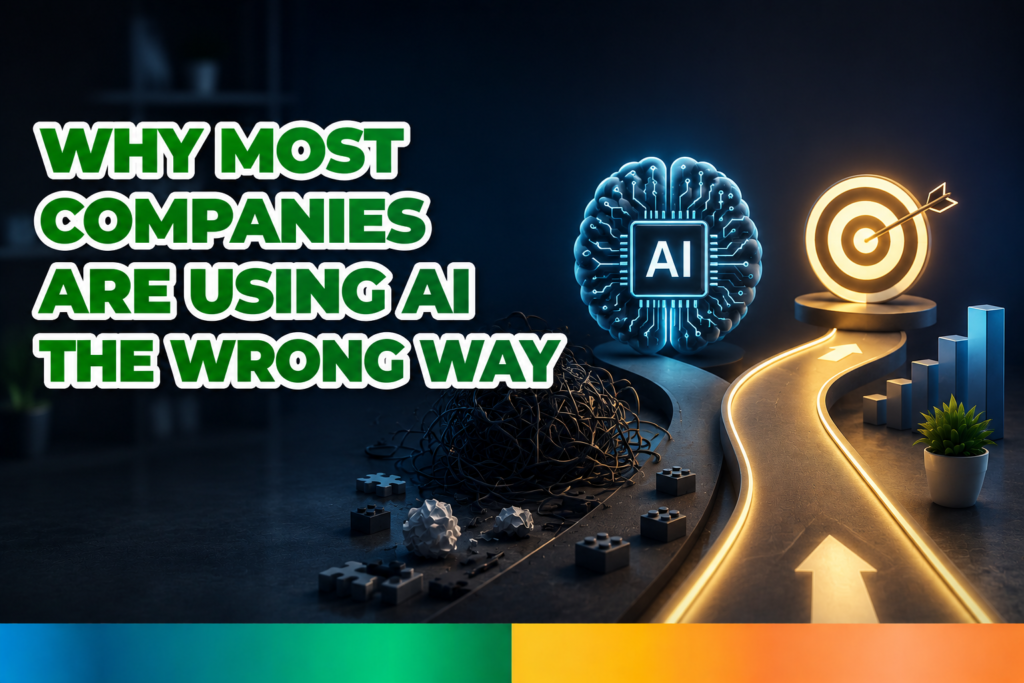
Ironically, that’s exactly why many AI initiatives fail. And don’t get us wrong: we LOVE AI. But we have identified the problem lies in how businesses approach it.
Many organizations treat AI as a product they can buy instead of a business strategy they need to design.
So, let’s look at the most common mistakes while implementing an AI strategy for your business and what successful companies are doing differently.
AI Strategy for Business: Mistakes to Avoid
Mistake #1: Buying AI before identifying the problem
One of the biggest misconceptions is believing that implementing AI automatically improves a business.
It doesn’t.
AI only creates value when it solves a specific business problem.
Many companies purchase expensive AI platforms before asking questions like:
- What process is consuming the most time?
- Where are we losing money?
- Which repetitive tasks slow down our team?
- What frustrates our customers the most?
Without those answers, AI becomes another unused software subscription.
So, instead of asking: “Which AI tool should we buy?”
Ask: “Which business problem should AI solve first?”
Start identifying the problem. Then choose the technology.
Mistake #2: Trying to automate everything at once
Another common mistake is attempting a complete AI transformation overnight.
This usually leads to confused teams, disconnected systems, and an overall poor adoption of the new tools.
Successful digital transformation works best when it happens gradually.
The companies seeing the highest ROI usually begin with one small automation that delivers immediate value.
Examples include:
- customer support responses
- meeting summaries
- invoice processing
- lead qualification
- sales reporting
- appointment scheduling
Remember: Small wins build confidence.
Mistake #3: Using AI without improving processes first
Artificial Intelligence makes broken workflows happen faster.
If your sales process is disorganized, AI can automate the chaos.
If your customer service process lacks consistency, AI can deliver inconsistent answers more efficiently.
Before implementing AI, businesses should optimize their workflows first.
Technology works best when it supports good processes.
Mistake #4: Ignoring the human experience
Many organizations focus exclusively on automation while forgetting about people. And who wants to give their customers a robotic experience?
At We Build It, we firmly believe AI should enhance human work, not eliminate human value.
The best AI systems reduce repetitive work, which helps employees make better decisions.
If you improve customer experiences, people remain at the center. And AI becomes the assistant- as it always should be.
Mistake #5: Measuring Activity Instead of Results
Many businesses celebrate metrics like number of prompts or tools used. But those numbers don’t matter if they don’t improve business performance.
Instead, focus on measuring outcomes like:
- hours saved
- reduction in operational costs
- faster response times
- increased conversion rates
If it makes your business grow, it works.
What successful companies do instead?
Companies getting real value from AI follow a much simpler framework.
Step 1: Audit current operations
Identify repetitive, manual, and time-consuming tasks.
Step 2: Prioritize high-impact opportunities
Focus on processes where automation creates immediate value.
Step 3: Design the workflow
Define how people and AI will work together.
Step 4: Choose the right technology
Only after understanding the workflow should tools be selected.
Sometimes the answer is ChatGPT, an AI agent or a CRM automation.
And sometimes it’s not AI at all.
Step 5: Measure and improve
AI implementation it’s an ongoing optimization process. The most successful businesses continuously analyze performance and improve their systems.
Where AI Creates the Fastest ROI
Most businesses need a few well-designed automations.
Some of the highest-impact use cases include:
Customer Support
Automatically answer common questions while routing complex conversations to your team.
Sales
Score leads, qualify prospects, generate proposals, and automate follow-ups.
Marketing
Generate personalized campaigns, create content drafts, segment audiences, and optimize email sequences.
Operations
Automate reports, approvals, document processing, scheduling, and internal notifications.
Executive Reporting
Turn scattered business data into dashboards and AI-generated summaries for faster decision-making.
AI Isn’t About Replacing People
One of the biggest myths surrounding AI is that it exists to replace employees.
In reality, the most successful organizations use AI to remove repetitive work so their teams can focus on:
- creativity
- innovation
- customer relationships
- strategic thinking
- problem solving
- … and all the fun stuff 🙂
The goal is giving people more time to do work that actually creates value.
Are you using AI with purpose?
At We Build It, we help businesses build an AI strategy that actually works.
Beyond AI hype, we design systems that integrate with your existing workflows, automate repetitive tasks, improve customer experiences, and deliver measurable business results.
Whether you’re exploring AI for the first time or looking to optimize existing systems, we’ll help you identify the highest-impact opportunities and build a solution tailored to your business.
Let’s build smarter systems together.
Contact We Build It today for a personalized AI strategy consultation and discover how automation can help your business grow faster, operate more efficiently, and stay ahead of the competition.
Frequently Asked Questions (FAQs)
What is an AI strategy for business?
An AI strategy is a structured plan for using artificial intelligence to solve specific business challenges, improve efficiency, reduce costs, and support long-term growth.
How can small businesses benefit from AI?
Small businesses can use AI to automate customer support, marketing, lead qualification, reporting, scheduling, and administrative tasks, allowing teams to focus on higher-value work.
Do I need custom AI software?
Not always. Many businesses achieve excellent results by integrating existing AI tools with their workflows. Custom solutions become valuable when off-the-shelf tools can’t meet specific operational needs.
What’s the first process I should automate?
Start with repetitive, high-volume tasks that consume significant time, such as email responses, data entry, reporting, appointment scheduling, or lead management.
How long does AI implementation take?
Simple automations can often be implemented within days or weeks. More advanced AI solutions involving integrations, custom workflows, or multiple departments may take several months depending on complexity.